
How PVC Pipe Machine Operators Are Trained for Quality-Conscious Production Across Multiple Product Lines
Different PVC pipe products can pass through the same factory while requiring noticeably different operating decisions. Pressure pipe, drainage pipe, and conduit may share basic extrusion principles, yet their formulations, dimensions, cooling requirements, and inspection criteria are not interchangeable.
A well-designed PVC pipe machine operator training programme should teach personnel to recognize those differences before changing temperatures or line speeds. DEKUMA supplies PVC extrusion systems for water supply, drainage, irrigation, ventilation, wire protection, industrial, and gas applications, making multi-product operation a relevant training scenario.
Building Product-Specific Process Knowledge
Training should begin with the product specification rather than the control panel. Pressure pipe requires attention to pressure class, wall dimensions, and applicable requirements; ISO 1452-2 covers PVC-U pipes for water supply and pressure drainage and sewerage, including dimensional and test requirements. Non-pressure underground drainage follows a different standards framework, such as ISO 4435, while conduit may be evaluated primarily around electrical protection and dimensional compatibility.
Material preparation deserves its own module because rigid PVC formulations can vary in stabilizer, modifier, lubricant, filler, and impact-modifier content. A change in formulation can alter plasticization behavior and melt characteristics even when the nominal pipe diameter remains unchanged. Operators should learn to identify the approved recipe, verify material batches, and understand which process parameters are allowed to move within the production specification.
The training record should also distinguish setup knowledge from product knowledge. An operator may understand how to start the extruder but still lack the judgment required to recognize why a pressure-grade formulation needs a different operating window from a drainage compound. Written setup sheets, approved parameter ranges, material identification, and changeover checklists can turn that knowledge into a repeatable production routine.
Teaching Machine Setup by Product
A PVC pipe manufacturing machine should be taught as an interconnected process rather than as separate pieces of equipment. Screw speed influences melt throughput, haul-off speed affects material distribution, while die temperature and vacuum calibration influence the geometry established downstream. Training should explain these relationships so operators understand the reason behind each setting instead of memorizing isolated numbers.
DEKUMA’s DKM-EII51/105 double conical twin-screw extruder has a 51/105 mm screw configuration, 1,060 mm effective screw length, 22 kW main motor, and a listed maximum output of 100–120 kg/h. The larger DKM-EII65/132 is listed at 280–350 kg/h, while the DKM-EII80/156 reaches 400–550 kg/h. These configurations demonstrate why training materials need to be linked to the actual equipment installed in a factory rather than copied from a generic extrusion manual.
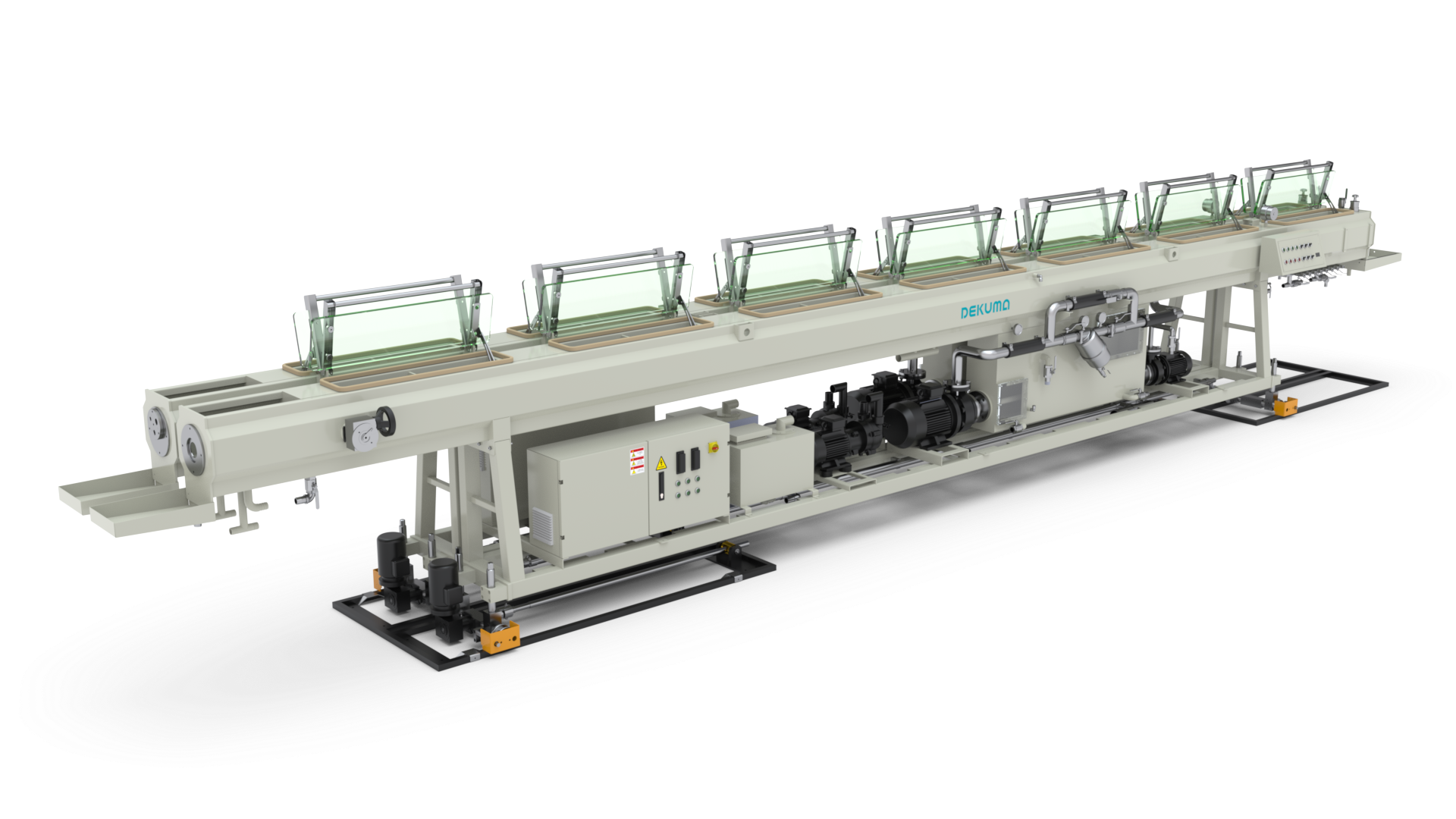
Downstream equipment requires equal attention. The vacuum calibrator uses stainless-steel construction, dual water circulation, independent filtration, rapid vacuum response, and automatic water-temperature and level control. Operators should learn how a blocked nozzle, unstable vacuum, or altered cooling condition can affect outside diameter and surface quality. Single- and double-chamber arrangements also require equipment-specific instructions rather than one universal procedure.
Assessing Operators Before Independent Production
A practical assessment should begin with a controlled setup exercise. The trainee can be given a product specification, material identification, target dimensions, and approved process window, then asked to prepare the machine without relying on another operator. The evaluator can observe whether the trainee verifies the recipe, checks tooling, confirms cooling conditions, and follows the correct startup sequence.
Quality inspection should form the second stage. Depending on the product, operators may need to measure outside diameter, wall thickness, ovality, length, socket dimensions, surface condition, and other specified characteristics. For pressure applications, the inspection plan should also connect production measurements with the relevant product standard rather than treating visual appearance as sufficient evidence. ISO 1452-5, for example, addresses fitness-for-purpose requirements for PVC-U pressure piping systems and associated joints.
Troubleshooting can provide the final test of independent readiness. Instead of asking an operator to reproduce a memorized procedure, an assessment can present realistic deviations such as fluctuating dimensions, unstable vacuum, uneven wall thickness, or surface defects. The operator then identifies possible causes, checks the relevant process data, makes an authorized adjustment, and records the result. Such testing reveals whether the person can interpret production conditions rather than merely operate buttons.
Conclusion
Multi-product extrusion competence develops through repeated links between material, equipment, specification, and inspection. PVC pipe machine training becomes more useful when each product have their own setup sheets, critical quality points, acceptable parameter ranges, and changeover procedures. Standards such as ISO 1452 and ISO 4435 further demonstrate that pressure and non-pressure PVC piping cannot be treated as identical products simply because they share the same basic polymer family.
A mature training system for PVC pipe manufacturing machine operators should also separate authorization levels. New operators can first learn material handling and routine inspection, then progress to machine setup, parameter adjustment, troubleshooting, and independent production. This staged approach gives supervisors a clearer basis for deciding whether an operator is ready to handle another product family.
DEKUMA‘s PVC extrusion portfolio includes twin-screw processing, extrusion die heads, vacuum calibration, synchronized haul-off, and cutting equipment, so training can be organized around the actual sequence of the production line rather than isolated machine functions. A strong operator programme ultimately makes product changeovers more disciplined. It also gives quality personnel clearer evidence that independent operation has been earned through demonstrated process knowledge.